2026
MarketPilot
An AI marketing, SEO, and GEO platform — point it at a client site and it crawls, scores, finds the competitive gaps, and turns every finding into agent-ready work.

Stack
Angular 22 · NestJS 11 · Firebase · Firestore
Outcome
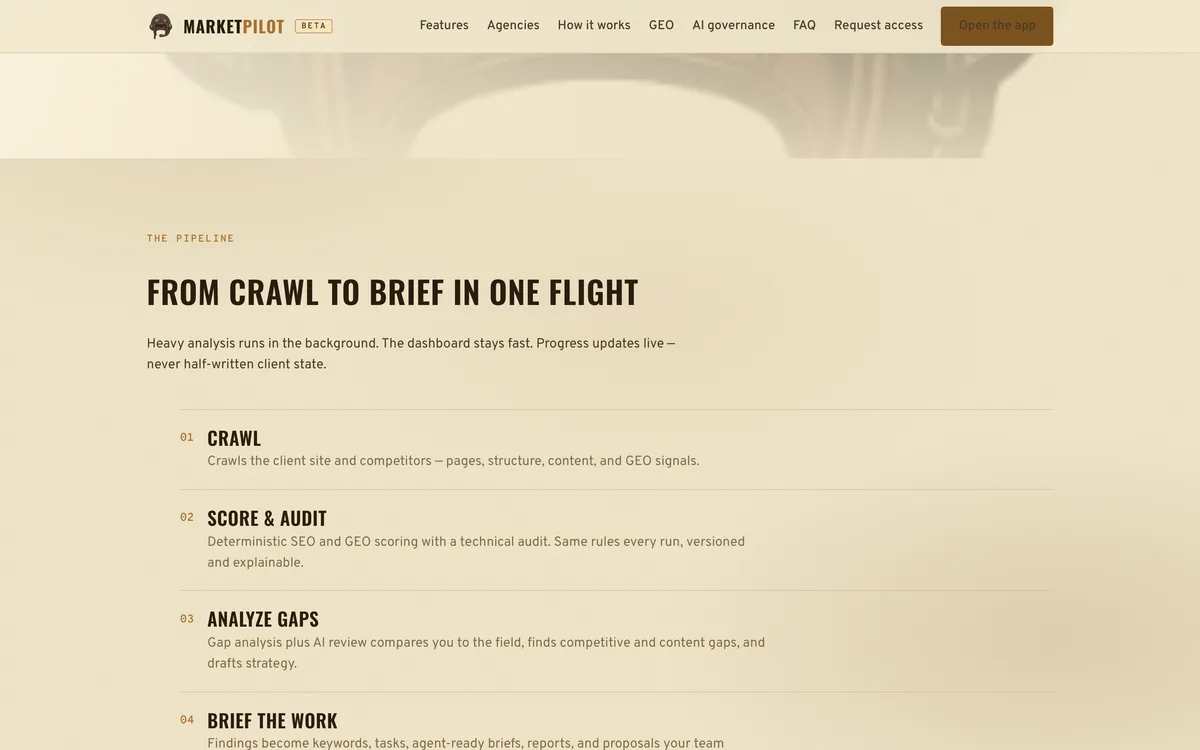
One pipeline from crawl to brief: crawl → deterministic + AI scoring → gap analysis → agent-ready work
The problem
SEO tooling tends to stop at the diagnosis. You get a score, a pile of issues, and a CSV — and then a human still has to translate all of it into work someone can actually do. Agencies feel this worst: every client audit becomes hours of manual interpretation before a single task reaches a writer or a developer. On top of that, AI answer engines had become a real traffic source that none of the incumbent tools measured at all.
The build
MarketPilot runs the whole mission in one pipeline: crawl the client site and its competitors, score them, analyze the gaps, then brief the work. Scoring is deliberately split — a deterministic, versioned score for the things that should give the same answer every run (metadata, structure, readability, structured data, links, conversion), blended with a grounded Gemini pass for the judgment calls (content depth, E-E-A-T, clarity, persuasion, differentiation). Because the deterministic half is version-stamped, two runs are genuinely comparable before and after a fix. The output is the differentiator: findings become target keywords, tasks, and implementation briefs written to be handed straight to a coding agent. It is built multi-tenant with multi-workspace tenancy and white-label branding, on Angular 22 with a NestJS 11 API, Cloud Tasks for the long-running analysis, and Cloud KMS for tenant credentials.
Keeping the two halves of the score separate is what makes a re-run mean anything. When a number moves, you can tell whether the site actually changed or the model simply had a different opinion that day — which is the failure mode that makes most AI-scored audits impossible to trust over time.
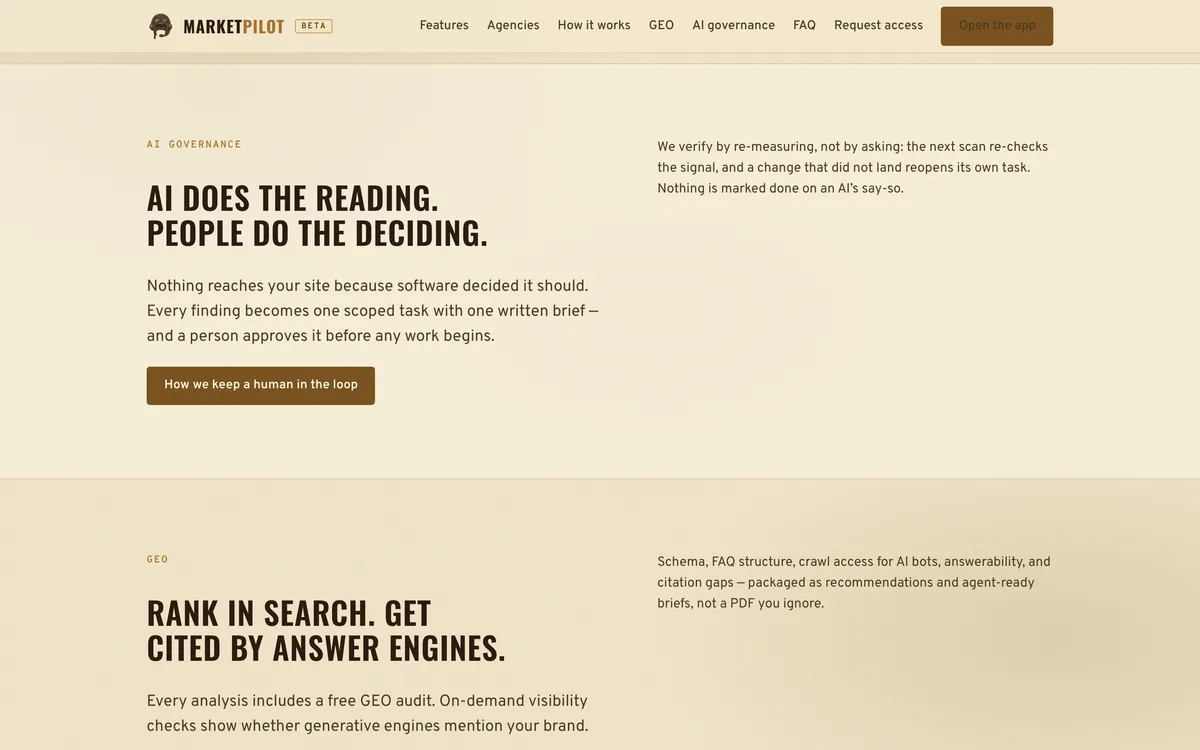
GEO is treated as a first-class surface rather than a bolt-on, because AI answer engines had quietly become a real traffic source that none of the incumbent tools measured. The uncomfortable metric is AI Answer Visibility: it asks live answer engines the questions a real buyer would ask and counts how often the client is actually cited, next to a leaderboard of who got cited instead. Plenty of sites that score well on conventional SEO discover they are invisible here.
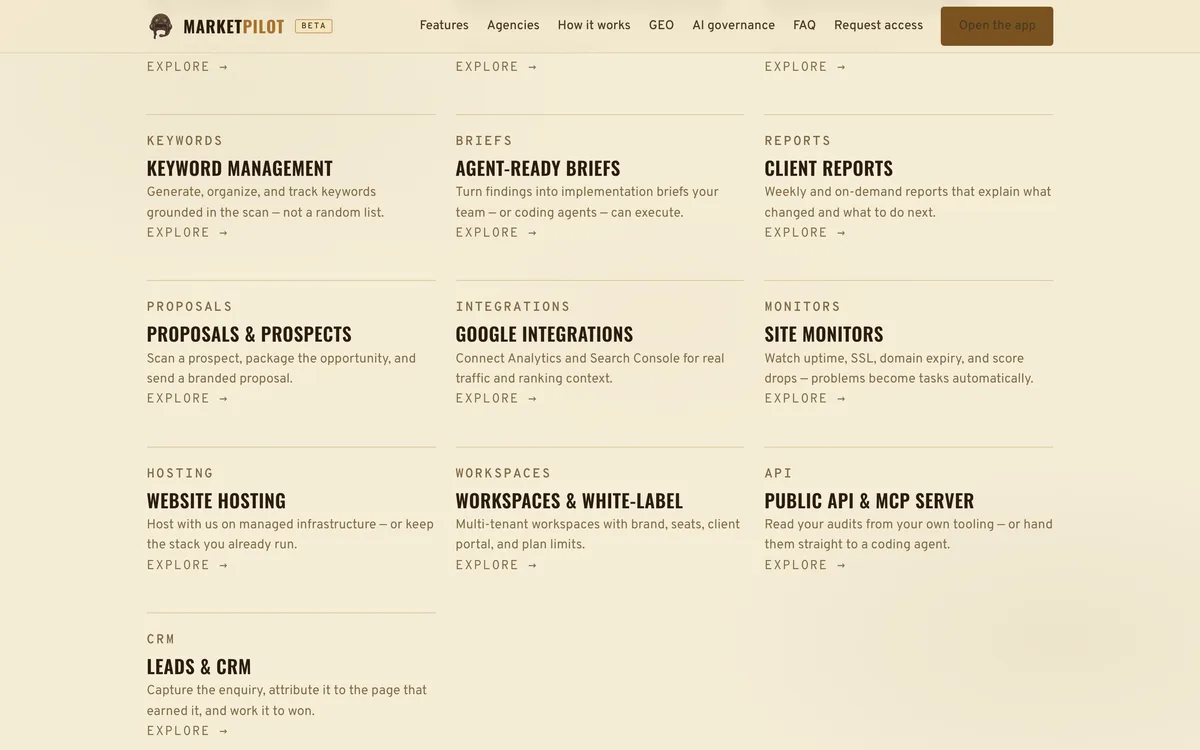
The handoff is the part that earns its keep in an agency. Findings do not stop at a list of issues — they become target keywords, a competitive strategy, and implementation briefs specific enough to hand to a writer, a developer, or a coding agent without a human translating first. A built-in MCP server takes that one step further: an agent can pull audits and recommendations directly rather than scraping a dashboard.
The engineering constraint throughout was that deep analysis is slow and dashboards must not be. A self-hosted crawler tries static fetching first and falls back to headless only when it has to; the long work runs on Cloud Tasks and reports progress live, so navigating away and coming back never leaves half-written client state on screen. Tenant credentials are sealed with Cloud KMS, which multi-tenancy and white-labeling made non-negotiable.
See it at marketpilotseo.com.


The outcome
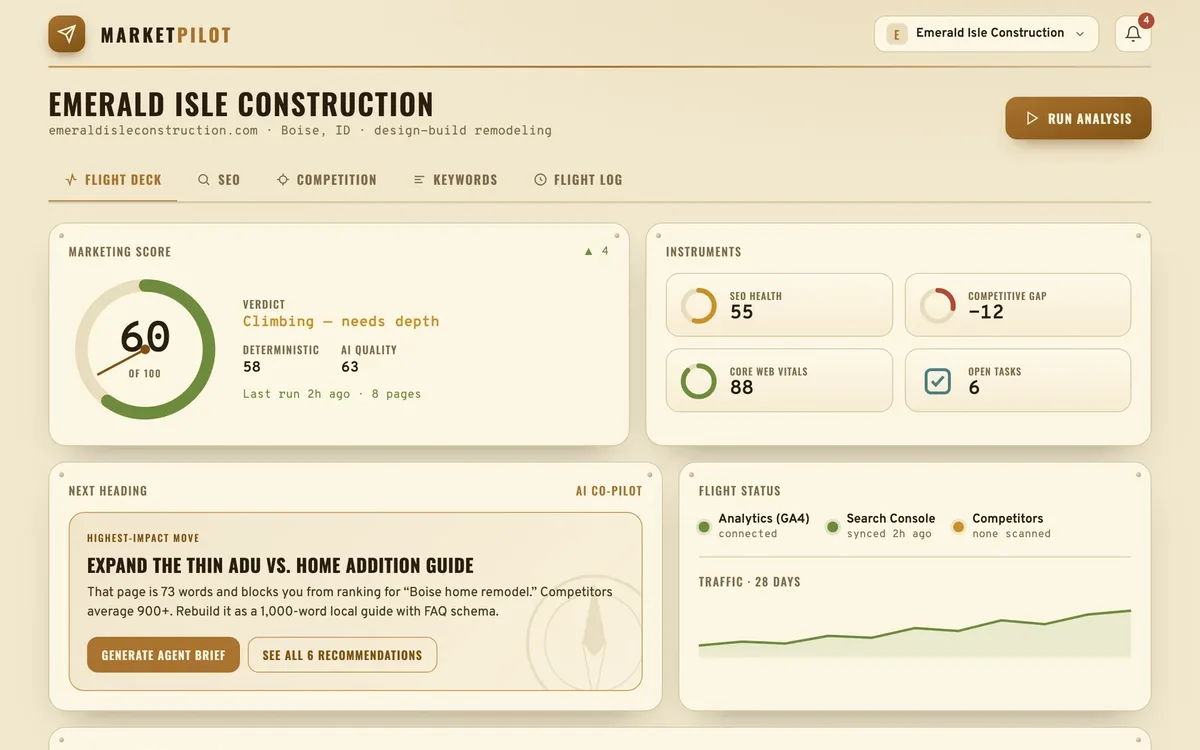
It ships as a mobile-first 'flight deck' dashboard — a marketing-score gauge, an instrument cluster, the AI-picked next action, and live flight status while heavy analysis runs in the background. Beyond conventional SEO it scores GEO on five pillars (AI-crawler access, answer-readiness, structured data, authority and trust, factual density) and measures AI Answer Visibility: whether live answer engines actually cite the brand, with a competitor citation leaderboard. Keyword volume and difficulty come from the Google Ads Keyword Planner, Core Web Vitals from PageSpeed Insights, and the platform generates client reports and proposals at the end of the run.
- One pipeline from crawl to brief: crawl → deterministic + AI scoring → gap analysis → agent-ready work
- Versioned deterministic scoring, so before/after runs are directly comparable
- 5-pillar GEO readiness score plus AI Answer Visibility — measures whether answer engines cite the brand
- Multi-tenant, multi-workspace, white-label; tenant credentials sealed with Cloud KMS
- Background analysis on Cloud Tasks with live progress that survives navigating away
- Google Ads Keyword Planner volume/difficulty and PageSpeed Insights Core Web Vitals
- Ships an MCP server, so agents can pull audits and recommendations directly
Have a similar problem?
Book a 30-minute call and we'll scope it together — no pitch, just a plan.
Book a call →